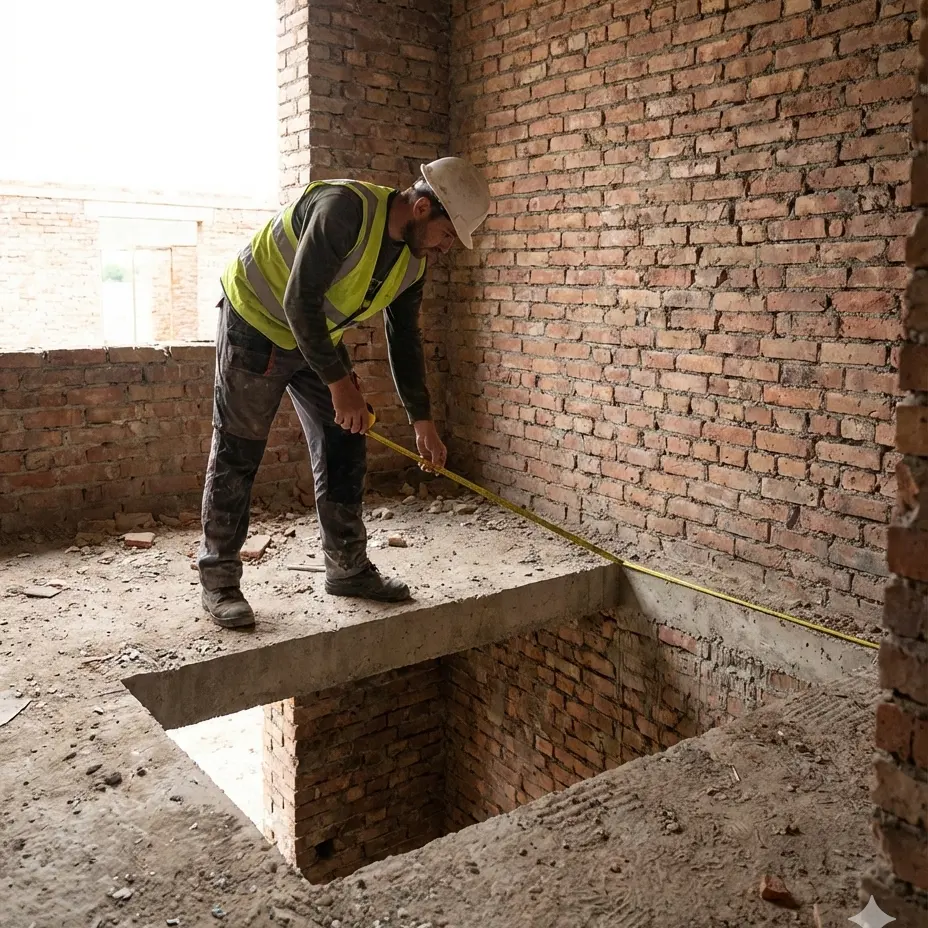
The staircase that transforms your home
The staircase is not simply a functional element - it is an architectural statement. It is the first thing a visitor sees upon entering, and the element that most influences the perception of space, light and style. Choosing the right staircase requires thinking carefully about four essential dimensions: the space available, the materials, the style and the practical aspects of installation.
Step 1: Measure your available space
Before choosing any model, you need to know three crucial measurements:
- Floor-to-floor height - the distance between the finished floor of the lower level and the finished floor of the upper level. This is your most important measurement.
- Available footprint - the floor area you can allocate to the staircase. This determines whether you can opt for a straight flight, a quarter-turn, or a compact space-saving design.
- Ceiling opening - the opening in the upper-floor slab through which you will pass. This influences the staircase width and minimum headroom.
As a general rule: for a floor height of 270 cm and a standard riser height of 18 cm, you will need approximately 15 treads. For a straight flight 80 cm wide, that equates to around 3 metres of floor length.
Step 2: Choose the right type of staircase
Straight staircase
The classic choice. Maximum simplicity, easy installation, easy cleaning. Requires the most floor space but offers the most comfortable ascent and descent.
Quarter-turn staircase
Changes direction by 90 deg - either through a winder section or a landing. Ideal for spaces where a straight flight does not fit, but where you still want comfortable dimensions.
Space-saving staircase
With alternating (samba) treads, it fits into a much smaller footprint. Perfect for duplex apartments or loft conversions where every square metre counts.
Compact staircase
Designs such as the Lumia or Velora, with curved treads and a narrow profile, are solutions for very tight spaces - minimum floor openings from 1425 x 635 mm.
Semi-spiral staircase
A quarter-turn with a circular form - the Siena model, for example. Fits into less than 1.5 m2 and creates a dramatic visual impact.
Step 3: Select your materials
Solid beech
European beech is the standard for interior staircase treads. Dense, resistant, with a fine and uniform grain. Can be lacquered, stained or waxed. At SCALUX it comes in natural lacquered finish or walnut-stained.
Solid pine
Softer and warmer than beech, ideal for rustic and traditional interiors. The RUSTIC model uses solid pine or beech with unfinished treads for complete personalisation.
Lacquered multiplex
Used in the QUADRO model. Dimensionally stable, resistant, with a uniform factory finish. Ideal for contemporary spaces.
Powder-coated steel
The structural backbone of most SCALUX models. Available in white, grey or black. Resistant, precise, and maintenance-free.
Step 4: Match the style to your interior
- Modern minimalist - LONDON, MANHATTAN, TORINO: clean lines, central structure, neutral colours.
- Industrial - CYVA, QUADRO: visible metalwork, honest materials, no ornamental excess.
- Scandinavian - SCALA, LUMIA, VELORA: light timber, white or grey frame, airy design.
- Rustic / Traditional - RUSTIC: solid pine, optional balustrades, warm and timeless.
- Space-saving - SCALA, LUMIA, VELORA, SIENA: compact footprint without aesthetic compromise.
Step 5: Think about safety and balustrades
A staircase is only as good as its balustrade. Consider:
- Balustrade height - minimum 90 cm, recommended 100 cm for families with children.
- Balustrade type - included with most SCALUX models. Optional extras available for the landing level.
- Handrail - metal or beech handrail, depending on the model and your preference.
Step 6: Practical installation advice
- Most SCALUX models come as complete kits with detailed installation instructions.
- Technical advice is available free of charge - by phone or online.
- Measure twice, order once: check the floor height, available footprint and ceiling opening before placing an order.
- Allow for the finish on unfinished treads before installation: staining or lacquering is best done before fitting.
Conclusion
The perfect interior staircase is the one that fits your space exactly, suits your style and can be installed without stress. At SCALUX, every model has been designed with this in mind: modular systems that adapt to your architecture, not the other way round.
Contact us for a free consultation - we will help you find the ideal solution for your home.
Need a premium interior staircase?
Our team can help you choose the right solution for your home.
Request Free Consultation